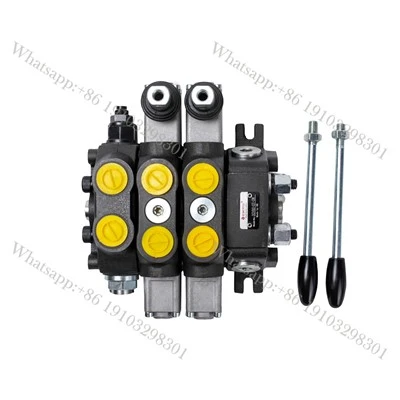
Shijiazhuang Laiye Import& Export Trading Co., Ltd. is one of the leading manufacturers and suppliers of SD25 Manual Sectional Directional Control Valve in China, also supports customized service. If you're going to wholesale high quality SD25 Manual Sectional Directional Control Valve made in China, welcome to get pricelist from our factory.
Products Description

This page is for the people who actually work on SD25 SD25 Manual Sectional Directional Control Valve - technicians, maintenance crews, and field service engineers. It's not a product brochure. It's not about specs and ordering. It's about what to check when you install one, how to keep it running, and what to do when something goes wrong. If you're looking for the spec sheet, that's on the product page.
The SD25 is a monoblock valve. That means the body is one casting, not a stack of separate sections. Up to 10 sections, all machined into a single piece of iron. This changes how you maintain it. There are no tie rods to torque, no section seals to replace. But it also means you can't pull out one section and swap it. Keep that in mind as you read through this.
Installation Checks
A lot of problems start at installation. Get these right, and you avoid most of the headaches later.
Mounting surface. It has to be flat and clean. If it's not, tightening the bolts will distort the body. When the body distorts, the spools bind. Check it with a straight edge before you set the valve down.
Bolt torque. Tighten the bolts evenly, in sequence. Don't just crank one down and move to the next. Uneven torque is the number one cause of a distorted monoblock body. Use a torque wrench. Don't guess.
Flush the lines first. This is not optional. Any debris left in the piping will end up inside the valve. It'll score the spool bores or block a passage. Flush everything before you connect.
Port connections. Inlet is G1 1/4. Work ports are G1. Make sure your fittings match. Cross-threading or over-tightening will damage the port and cause a leak.
First start. Put all levers in neutral. Start the pump, let it idle for a few minutes. Then cycle each section through its full range a few times to purge air. If a cylinder moves the wrong way, swap the A and B lines on that section.
Routine Maintenance
Keep the oil clean. Filtration requirement is ≤10 μm. Contamination is what kills these valves. It causes spools to stick and seals to wear. Change filters on schedule. Don't skip it.
Look for leaks. Check the mounting face and port connections regularly. A small weep usually means a damaged O-ring or an uneven mounting surface. Fix it before it turns into a bigger leak.
Check the levers. Each lever should return to neutral when you let go. If one feels stiff or doesn't center, the spring might be broken, or there's contamination in the spool bore.
Watch the oil temperature. Ambient range is -40°C to +80°C. If the oil runs hot, check the relief valve setting and the cooler. Hot oil thins out, and thin oil leaks more.
Check back pressure. Tank port back pressure is rated at ≤1 MPa. If the return line carries back pressure from other functions, make sure it stays under that. Get close to 1 MPa and the spool may not shift reliably.
Fault Diagnosis
A section doesn't respond. Most likely the spool is stuck. Could be contamination, a broken spring, or a bent lever linkage. Pull the end cap and look at the spool. If it's scored or stuck, you've got a problem.
A function moves slowly. Check the pump output and relief valve first. If those are fine, you might have internal leakage in that section. The reference is 15 cc/min at 160 bar. If it's a lot higher, the spool or bore is worn.
A function drifts under load. Either the load check valve is leaking, or the spool isn't centering all the way. Check centering first. If that's fine, look at the load check.
All sections fail at once. That's not a section problem. It's something common - oil level, oil viscosity, suction filter, or pump output. A clogged suction filter or low oil will affect every section.
Leak at the mounting face. Check the surface and the O-rings. Uneven bolt torque is a common culprit. Re-torque evenly and replace any damaged seals.
Noisy valve. Usually air in the oil or a restricted inlet. Check the oil level and suction line. Bleed the system if there's air. A high-pitched whistle might mean a blocked passage.
Service and Replacement
Because the SD25 is monoblock, there are no separate sections to remove. If one circuit fails and can't be repaired, the whole valve usually has to be replaced or sent back. That's the trade-off with this design. When you order a replacement, tell them the number of sections, the spool functions, and the port configuration. If it's still under warranty, call the supplier before you try to fix anything yourself.


Products Description

The SD25 is produced by Shijiazhuang Laive Import & Export Trading Co., Ltd., part of Hebei Onederful® Hydraulic Technology Co., Ltd. The company was founded in 1988 and has more than 35 years of experience in pressure valve components. For full company information, visit About Us.

01
OEM options
Change float position, add pilot‑operated check, or custom lever length. Just send your drawing.
02
Flexible packaging
Cartons for small orders, export plywood cases for pallets.
03
Shipping
Sea, air, DHL/FedEx/UPS. We consolidate mixed valve models in one container.
04
Warranty
12 months against B/L date. If a spool seizes or a body cracks due to our workmanship, we replace it – no runaround.
Certifications


FAQ
Q: What happens if one circuit fails on the SD25 Manual Sectional Directional Control Valve?
A: Because the SD25 is a monoblock valve, the body is a single casting. There are no separate sections to remove or replace. If one circuit fails, the whole valve usually has to be replaced or sent back for service. You cannot swap out just the affected section. That is the main trade-off of the monoblock design.
Q: Can I add a hydraulic function later?
A: No. The number of sections is fixed when the valve is produced. If you think the machine may need another function down the road, a sectional valve is the better choice from the start.
Q: How do I know if I should choose the SD25 or a sectional valve?
A: It comes down to two things: how many functions the machine will have over its life, and how you want to handle service. If the function count is fixed and you want fewer leak paths and no tie rods to torque, the SD25 is a good fit. If the function count may grow, or if you need to replace one section without pulling the whole valve, go sectional.
Q: What is the maximum flow and pressure?
A: The SD25 is rated at 240 L/min maximum flow. Maximum working pressure is 315 bar on ports P, A, and B. The nominal pressure is 16 MPa.
Q: Why is the tank port back pressure limited to 1 MPa?
A: The T port is rated at ≤1 MPa. If return line back pressure gets close to that limit, the spool may not shift reliably. In circuits where the return line carries back pressure from other functions, size the return line generously. This is a system design issue, not a valve defect.
Hot Tags: SD25 Manual Sectional Directional Control Valve, China SD25 Manual Sectional Directional Control Valve, manufacturers, suppliers, factory, 80 liter sectional directional valve, P80 Series Hydraulic Directional Valve, monoblok directional valve, 120 liter hydraulic directional valve, SD5 Series Hydrauic Sectional Valve, 5 levers monoblock directional valve