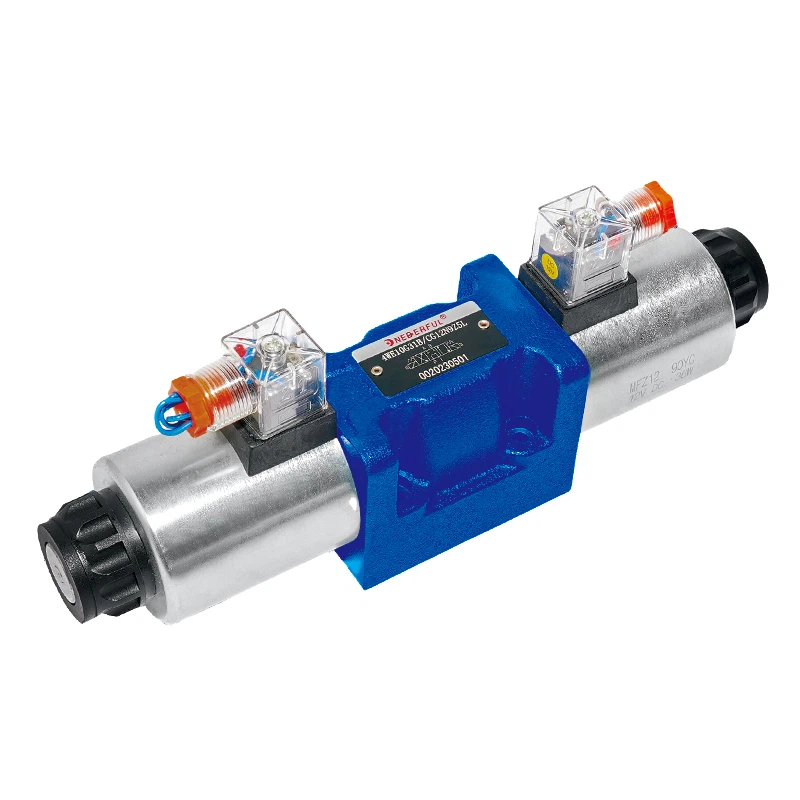
Shijiazhuang Laiye Import& Export Trading Co., Ltd. is one of the leading manufacturers and suppliers of sv20 pilot-operated check valve in China, also supports customized service. If you're going to wholesale high quality sv20 pilot-operated check valve made in China, welcome to get pricelist from our factory.
Product Description

Basic Information
Operating Principle: Normally closed when de-energized; the poppet opens when energized, allowing bidirectional fluid flow.
Operating Pressure: Up to 315 bar, depending on the specific model.
Maximum Flow Rate: Up to 350 L/min.
Internal Leakage: Extremely low leakage at rated pressure; as low as 1 mL/min for some models.
Coil: Continuous duty, wet-armature design; IP69K waterproof rating available.
Manual Override: Optional feature for on-site commissioning and emergency use.
Key Features
1. Hardened valve seat for durability and low leakage
2. Multiple voltage and terminal options; interchangeable coil voltages
3. Compact threaded cartridge design for easy installation
Application Scenarios
Construction Machinery and Mobile Equipment: The SV20 pilot-operated check valve is commonly used in equipment such as excavators and cranes; by locking the cylinder circuit in both directions, it ensures that booms, buckets, or lifting arms remain securely in position, preventing accidental descent caused by gravity or external forces.
Heavy-Duty Industrial Hydraulic Systems: In industrial applications requiring pressure maintenance or the prevention of uncontrolled load movement (such as large presses and injection molding machines), the SV20 pilot-operated check valve enables zero-leakage load holding and locking.
Safety and Emergency Component: Featuring an integrated manual emergency override function, the valve's state can be manually switched during electrical failures or emergencies, providing a critical backup solution for equipment commissioning and safe shutdowns.
| Product parameters | |||
| Specification | 20 | ||
| Max working pressure Mpa | 31.5 | ||
| Max flow (L/min) | 350 | ||
| Design number | 40 | ||

Product Structure
Main body: The housing that accommodates all internal components; it features cast-in oil passages to connect the various ports.
Valve spool: The core moving component within the valve that controls the opening, closing, and switching of oil circuits; it shifts position to alter the connections between ports.
Spring: Used to return the spool to its original position (e.g., returning to the neutral/initial state after power is cut or the handle is released) or to provide the biasing force for relief valves or check valves.
Handle: The manual operating component connected directly to the spool, used to manually shift the spool position and actuate flow switching.
Relief valve: A safety component that limits maximum system pressure to prevent overload; it opens to relieve pressure when the system pressure exceeds the set value.
Check valve: Allows fluid flow in only one direction and prevents reverse flow.
O-ring: Used for static and dynamic sealing at mating surfaces to prevent fluid leakage.
Port: The inlet and outlet connections on the valve body (e.g., Port P for supply, Port T for return, and Ports A/B for connection to actuators).
Fully In-House Manufacturing: The entire process-from casting to the finished product-is completed in-house without reliance on external contractors.
High-Precision Machining: CNC machining precision reaches ±0.005mm, ensuring a precise fit between the valve spool and the valve bore.
Precision Casting and Heat Treatment: Features precision-cast ductile iron; valve spools undergo carburizing and quenching, achieving a surface hardness of HRC 58–62 and a threefold increase in wear resistance.
Imported Seals and Automated Assembly: Utilizes imported seals (e.g., Parker) and automated assembly lines; leakage rate is maintained at <5 drops/minute.
Comprehensive Factory Inspection: Every unit undergoes pressure pulse, internal leakage, and switching response testing; 100% inspection is guaranteed.
Basic Process
Casting → Machining → Heat Treatment → Surface Treatment → Component Inspection → Assembly → Final Inspection → Packaging → Shipment

Certifications


How to cooperate with us

1. Submission of Product Requirements
Clients provide details such as equipment type, hydraulic system parameters, product models, or operational requirements; our technical team then recommends the optimal hydraulic solution based on actual working conditions.
2. Confirmation of Product Solution
We finalize specifications-including pressure ratings, flow requirements, control methods, port configurations, and customization details-based on client needs to ensure seamless integration with the equipment system.
3. Sample Testing and Validation
We facilitate sample testing, allowing clients to verify product performance through actual equipment operation and confirm suitability for their applications before proceeding to bulk procurement.
4. Mass Production and Quality Control
Upon order confirmation, we initiate standardized production, strictly implementing raw material inspections, in-process checks, assembly and commissioning, and performance testing to ensure consistent product delivery.
5. Export Packaging and Delivery
We provide professional packaging solutions tailored to the client's location and chosen transport method, coordinating with international logistics (such as sea or air freight) to ensure safe and timely delivery.
6. Long-Term Partnership Support
We offer ongoing technical support, product supply, and after-sales service, fostering stable, long-term partnerships with clients worldwide.
FAQ
Q: What kind of valve is the SV20, and what are its primary functions?
A: The SV20 is a solenoid-operated, two-way, two-position, poppet-style, normally closed screw-in cartridge valve. It acts as a safety lock in hydraulic circuits, enabling precise flow control and bidirectional load holding in high-pressure, high-flow systems.
Q: Does the SV20 pilot-operated check valve support manual emergency operation?
A: Yes, certain SV20 models offer optional manual emergency operation devices-such as push-and-detent, push-pin, push-button, or twist-style mechanisms. This allows the valve spool to be manually actuated during on-site commissioning or in case of solenoid failure, enabling emergency circuit switching or load release.
Q: How can you determine if the SV20 solenoid coil has burned out?
A: Common causes include excessive supply voltage, coil moisture, and armature jamming resulting in sustained high current.
Q: Can the SV20 check valve be used in high-frequency switching applications?
A: It is not recommended. The SV20 features a poppet valve design involving spool travel during switching; high-frequency switching would accelerate wear on the poppet sealing surfaces.
Q: What causes the SV20 hydraulic valve O-ring to extrude?
A: Excessive installation torque or a defective chamfer on the mounting bore. Practical insight: Excessive installation torque can deform the O-ring through extrusion.
Hot Tags: sv20 pilot-operated check valve, China sv20 pilot-operated check valve, manufacturers, suppliers, factory, directional flow control valve, hydraulic dcv valve, hydraulic directional, pilot operated dc valve, sectional valve, solenoid controlled hydraulic valves