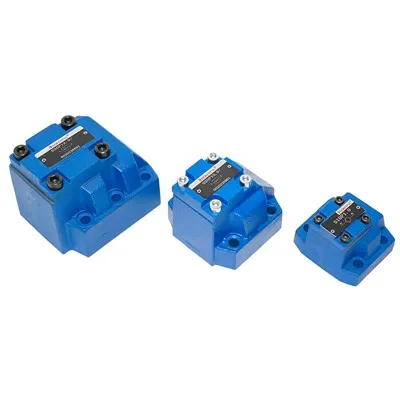
Shijiazhuang Laiye Import& Export Trading Co., Ltd. is one of the leading manufacturers and suppliers of sd8 multi-way directional valve in China, also supports customized service. If you're going to wholesale high quality sd8 multi-way directional valve made in China, welcome to get pricelist from our factory.
Products Description

Basic Information
The SD8 multi-way directional valve is a medium-flow sectional directional control valve featuring a modular, stackable design. It offers a rated flow of 90 L/min and a maximum operating pressure of 315 bar, with configurations ranging from 1 to 12 sections. It operates within a temperature range of -40°C to 80°C and is suitable for hydraulic fluids with a viscosity of 15–75 mm²/s. Each section is individually cast, and the complete valve assembly is formed by bolting the sections together. A wide range of control options is available, including manual, hydraulic, pneumatic, electric, electro-hydraulic, solenoid, flexible cable, and joystick controls.
Application Scenarios
The SD8 multi-way directional valve is widely used in equipment such as small-to-medium excavators, skid-steer loaders, compact wheel loaders, forklifts, telehandlers, aerial work platforms, motor graders, dump trucks, drilling rigs, road rollers, combine harvesters, and tractors. The sectional structure is particularly well-suited for mobile hydraulic systems that require coordinated multi-function control, the potential for adding attachment functions later, and ease of maintenance.
Product Advantages
Flexible Configuration: Sectional structure allows for combinations of 1 to 12 sections as needed; future expansion involves simply adding sections without replacing the entire valve assembly.
Easy Maintenance: Individual sections can be serviced independently without affecting the operation of other sections, thereby minimizing downtime.
Reliable Performance: High-precision spool fit ensures minimal internal leakage and rapid control response; a 315-bar pressure rating provides an ample safety margin for high-pressure applications.
Versatile Control Options: Supports manual, hydraulic, pneumatic, electric, electro-hydraulic, solenoid, flexible shaft, and joystick controls to suit various operational preferences.
Strong Adaptability: Stable operation in both cold and hot environments within the specified working temperature range.
Corrosion-Resistant and Durable: The valve body undergoes phosphating treatment after casting to enhance product durability.
High Cost-Performance Ratio: Offers performance comparable to imported products at a significantly more competitive price point.
Low Expansion Costs: Adding equipment functionality requires only the installation of additional valve sections, eliminating the need to replace the entire valve assembly.

How fluid enters the P-port
Pressurized oil from the pump is delivered through piping to the valve body's P-port (inlet port), which connects to the internal main oil passage. Once inside the valve body, the fluid waits to be directed based on the spool's position.
How the spool shifts
The SD8 features a sectional design, with spool movement controlled manually or electromagnetically. When the control handle is operated or the solenoid is energized, the spool shifts within the valve bore from its neutral position to either the left or right position. This movement alters the internal flow paths between ports, directing fluid to the required working port.
How fluid flows to the A/B ports
In the left position: Port P connects to Port A, allowing pressurized oil to flow out of Port A and drive the actuator (e.g., a hydraulic cylinder or motor); Port B connects to Port T, allowing return oil from the actuator's other chamber to flow back to the reservoir via Port B.
In the right position: Port P connects to Port B, allowing pressurized oil to flow out of Port B; Port A connects to Port T, allowing return oil to flow back to the reservoir via Port A.
In the neutral position: The connectivity between ports P, A, B, and T is determined by the spool's neutral function configuration (e.g., O-type for full closure, Y-type connecting A, B, and T, etc.).
How return oil flows to the T-port
Oil from the actuator returns to the valve body through Port A or Port B, passes through internal spool passages to the T-port (return port), and then flows back to the tank through the T-port piping. The backpressure at the SD8's T-port typically does not exceed 100 bar.
| Item | Parameters | |
| Nominal flow rate | 90 L/min | |
| Max pressure | 315 bar | |
| Operating range | 15~75 mm2/s | |
| Ambient temperature range | -40℃~80℃ | |
| Structure | 1~12 sections | |

About the company
Founded in 1988 and part of Hebei Wendefu Hydraulic Technology Co., Ltd., Shijiazhuang Laiye Import & Export Trading Co., Ltd. is a manufacturer that designs, produces, and sells hydraulic valves.
The company has a complete production chain-casting, machining, heat treatment, surface finishing, assembly, and testing-all done in-house, with no outsourcing. It's equipped with high-precision machining centers, CNC lathes, and specialized testing equipment. Key processes are CNC-controlled. Every product is rigorously tested before shipping, and valve bodies are phosphated and salt-spray treated for reliable corrosion resistance.
FAQ
Q: What should be noted during installation?
A: The piping must be thoroughly flushed; iron filings entering the valve body can easily cause the valve to jam. When assembling sectional valves, ensure the sealing rings lie flat without twisting, and tighten the bolts in stages following a diagonal pattern. Many on-site oil leakage issues are caused by uneven bolt torque. Use a torque wrench to tighten the bolts in stages following a diagonal pattern rather than relying on manual feel. Apply a small amount of hydraulic oil to the inter-section sealing rings before installation to lubricate them and prevent twisting during assembly.
Q: Can the valve plates for the SD8 hydraulic valve be purchased individually?
A: Yes. For on-site repairs, first identify the damaged plate and provide the original valve model and the position of the plate to be replaced; we can supply the specific plate separately. When combining new and old plates, replace the sealing rings as well. Use a marker to label the sequence of the plates during disassembly to avoid mixing up the order during reassembly.
Q: How often should the sealing rings between SD8 sectional valve sections be replaced?
A: There is no fixed schedule. Experience suggests that oil seepage between sections or loose valve sections indicates the sealing rings have aged. Under normal use, they generally last three to five years; it is best to check them whenever you change the oil. If you notice seepage between sections, try tightening the bolts first-often, simply tightening them resolves the issue. Replace the sealing rings only if the seepage persists after tightening.
Q: What is the maximum allowable return-line back pressure for the SD8 directional hydraulic valve?
A: The back pressure at the T-port generally should not exceed 100 bar. Practical experience suggests that return lines must be sufficiently large in diameter; high back pressure in many systems is caused by return lines that are too narrow or by clogged return-line filters. Excessive back pressure can hinder spool return, resulting in slower shifting or even a failure to shift.
Q: What is causing the oil leakage at the solenoid plug of the SD8?
A: It is likely due to the aging or damage of the solenoid push-pin seal. The push-pin seal is a wear part; simply replacing it should resolve the issue. We have encountered situations where customers thought the entire valve was defective and needed replacement, when in fact the problem was just a seal costing a few yuan. Be careful not to scratch the surface of the push-pin when replacing the seal.
Hot Tags: sd8 multi-way directional valve, China sd8 multi-way directional valve, manufacturers, suppliers, factory, dc valve in hydraulic, directional control valve spool, hydraulic dcv valve, hydraulic directional, pilot operated dc valve, solenoid controlled hydraulic valves