

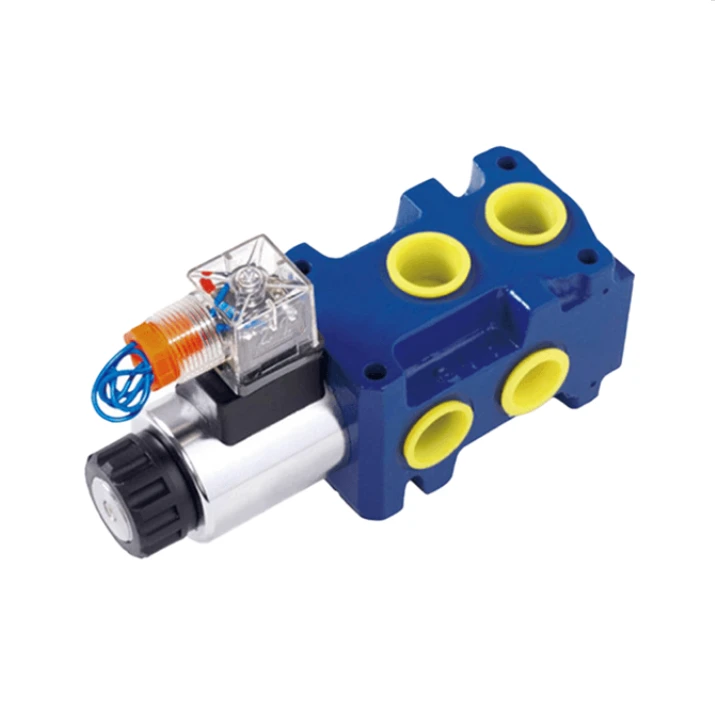


Shijiazhuang Laiye Import& Export Trading Co., Ltd. is one of the leading manufacturers and suppliers of mh6we6 series solenoid directional control valve in China, also supports customized service. If you're going to wholesale high quality mh6we6 series solenoid directional control valve made in China, welcome to get pricelist from our factory.
The Design Logic Behind a Solenoid Valve
Why you would choose a solenoid valve over manual levers
If you've spent time around excavators or wheel loaders, you know that the operator's hands are usually busy. The boom, the arm, and the bucket are controlled by manual levers that require constant attention. There are other functions on these machines, however, that don't need to be under the operator's hand at all times. Pilot pressure switching, emergency dump circuits, or interlocks that activate based on a sensor-these functions are better handled by electrical control. The MH6WE6 is built for those specific circuits. It takes an electrical signal from a simple switch, a joystick button, or a PLC and converts it into a mechanical shift of the valve spool.
Pressure and flow thresholds
The valve is rated for 250 bar at the main pressure and work ports, with a maximum flow capacity of 50 L/min. For most medium-duty circuits, this is more than sufficient. There is one detail that sometimes goes unnoticed: the tank return port (T port) is rated for a lower pressure of 50 bar. In most open-center return circuits, this is not a limitation. However, if your system has unusually high back-pressure in the return line, this value is something you should be aware of.
Why the NG6 interface is common
The MH6WE6 uses the NG6 (D03) mounting pattern. This is a standard footprint in the hydraulic industry. The four bolt holes and port spacing follow an international standard, which means you can replace an existing NG6 valve on a manifold without modifying the bracket.
AC and DC coil selection
You will need to select the coil voltage that matches your machine's electrical supply. The DC coils are available in 12V and 24V-the standard for mobile equipment running on batteries. The AC coils are available in 110V and 220V, which are common in stationary industrial machinery connected to mains power. Sending the wrong voltage to the coil will cause it to overheat quickly.
What Happens When You Energize the Coil
Shifting the spool
When you apply voltage to the solenoid coil, a magnetic field pulls the armature inside the coil. This armature pushes the valve spool out of its spring-centered neutral position. The spool shifts to open a path from the pressure port to one of the work ports, which sends oil to the connected cylinder or motor. When you cut the power, the spring pushes the spool back to neutral, and the cylinder stops moving.
The role of oil cleanliness
The spool and the bore are machined with very tight clearance. That clearance is what keeps internal leakage low and prevents the cylinder from drifting when the spool is centered. If the hydraulic oil is contaminated with fine particles, those particles can get lodged in the clearance and cause the spool to stick. A stuck spool will not return to neutral when the power is cut. This is why we recommend keeping the oil filtration at 25 microns or better.
The terminal housing
The electrical connections are covered by a transparent plastic housing. This makes it easy to inspect the terminals and the wiring without removing any covers. The wiring should be routed so it is not pinched between moving machine parts or exposed to heat sources.
Technical Specifications
Performance Parameters Table
| Parameter | Specification | What It Means on the Machine |
|---|---|---|
| Valve Size | NG6 (D03) | This is the standard mounting interface. It allows the valve to be fitted onto most common NG6 manifolds without adapters. |
| Max. Operating Pressure (P/A/B) | 250 bar | The maximum pressure the valve can handle at the pressure inlet and work ports. Running the valve above 250 bar may cause internal leakage or structural damage. |
| Max. Operating Pressure (T Port) | 50 bar | The maximum back-pressure allowed on the tank return port. If the return line back-pressure is higher than this, it can affect spool shifting performance. |
| Max. Flow | 50 L/min | The maximum flow rate the valve can handle efficiently. Operating the valve above 50 L/min will increase pressure drop and heat generation. |
| Working Voltage (DC) | 12V / 24V | DC coils are used in mobile equipment powered by batteries or a 24V vehicle network. Choose the voltage that matches your system. |
| Working Voltage (AC) | 110V / 220V | AC coils are used in stationary industrial machinery connected to mains power. Mismatched voltage will cause the coil to overheat or burn out. |
What to Check When You Install the Valve
Manifold face condition
Before you place the valve on the manifold, check that the manifold face is clean and free of scratches. Even a small scratch across a port opening can let oil bypass the O-ring and cause a seep.
Connecting the electrical wires
The terminal screws should be tightened to the torque specified for the terminal block. A loose connection can cause arcing and generate heat at the terminal. A connection that is too tight can damage the terminal itself.
Confirming the coil voltage
Before you connect the power, check the label on the solenoid housing. A 12V coil connected to a 24V supply will draw too much current and burn out quickly. A 24V coil connected to a 12V supply will not generate enough force to shift the spool fully.
Spool function
The valve is available with different spool functions. The most common is spring-centered, where the spool returns to neutral when you release the button. Some applications require a detented spool, which holds its position when the power is removed. Check that the function you have matches the requirements of the circuit.
Oil filtration
The spool and bore are machined to tight clearances. Contaminated oil is the most common cause of stuck spools. Maintaining oil filtration at 25 microns or better is the recommended practice.
Where You Typically See This Valve in the Field
Pilot control on mobile machinery
On excavators and wheel loaders, the MH6WE6 is often mounted in a separate valve block near the main directional valve. The operator uses a joystick or a small switch to send an electrical signal to the solenoid. That solenoid shifts the pilot valve, which sends a small flow of pilot oil to shift the main control valve. The physical effort for the operator is reduced, and the machine response becomes more predictable.
Industrial control panels and test benches
In industrial hydraulic power units, the MH6WE6 is often used as a direct-acting directional valve. It is mounted on a manifold block, and the electrical signal comes from a PLC or a button on a control panel. The compact NG6 size makes it easy to replace or integrate into an existing system without taking up much space.
Emergency shutdown circuits
The MH6WE6 is sometimes used in circuits where a cylinder must drop to tank immediately in an emergency. During normal operation, the solenoid holds the spool in one position. When an emergency stop button is pressed, the power to the coil is cut, and the spring shifts the spool to an open-center position that routes pressurized oil directly back to the tank. In this role, the MH6WE6 Series Solenoid Directional Control Valve provides a simple and reliable fail-safe function.
When you place an order, you will need to specify three configuration details:
Coil voltage: Select 12V DC, 24V DC, 110V AC, or 220V AC to match your machine's power supply.
Spool function: Choose spring-centered for momentary operation or detented for maintained positions.
Manual override: Some configurations include a manual override pin. This allows you to shift the spool manually by pushing the pin. It is useful for troubleshooting if the electrical system fails.
Phone Number
8615076180506
info@wendefuvalve.com


Raw material inspection
All incoming castings are inspected for cracks, porosity, and dimensional accuracy before entering the production line.
↓
CNC machining
Approved castings are machined on CNC centers. The port faces, mounting surfaces, and spool bores are cut to the specified tolerances. Parts are cleaned after machining.
↓
Spool production
Spools are turned and ground from solid steel bar stock to a precise surface finish. Each spool is matched to its corresponding bore during the sizing stage.
↓
Surface treatment
Machined bodies are processed through a phosphating bath to apply a rust-resistant conversion coating. Coating coverage is inspected after treatment.
↓
Coil testing
Solenoid coils are tested for electrical resistance and insulation integrity before assembly. Faulty coils are rejected at this stage.
↓
Final assembly
Valve bodies, spools, springs, and coils are assembled. O-rings are seated at the mounting interface. Manual override pins are fitted if specified.
↓
Bench testing
Every assembled valve is tested on a hydraulic bench. The valve is pressurized to 250 bar to verify seal integrity. The solenoid is energized to confirm full spool shift and return-to-neutral function.
↓
Packaging and labeling
Ports are sealed with protective plugs. The valve is wrapped and labeled with the model number and voltage specification.
↓
Ready for shipment
The finished valve is staged for shipping.
FAQ
Q: What is the difference between this valve and a manual sectional valve?
A: The MH6WE6 is a single-section solenoid valve, typically used for pilot control or individual circuit switching. A manual sectional valve (like the SD8 series) is a stackable valve with multiple sections that an operator controls directly with levers.
Q: What does the T port pressure rating of 50 bar mean?
A: The T port (tank return port) is rated for a maximum back-pressure of 50 bar. If the return line back-pressure exceeds this value, it can push against the spool and affect the shifting performance. In most open-center systems, the back-pressure is well below this limit.
Q: How do I know if the coil is burned out?
A: If the valve does not shift when the electrical signal is applied, the coil may be burned out. You can check the coil resistance with a multimeter. A short circuit or an open circuit indicates a faulty coil. Visual signs of overheating, such as discolored plastic, are also indicators.
Q: What is the recommended tightening torque for the mounting bolts?
A: The NG6 mounting bolts should be tightened to the torque specification provided with the valve. For standard metric bolts, a torque of approximately 5–8 N·m is usually recommended. We recommend tightening the bolts evenly in a cross pattern to ensure the valve sits flat on the manifold.
Q: Can I use this valve in a hydraulic system with a 315 bar pump?
A: The MH6WE6 is rated for a maximum operating pressure of 250 bar at the P/A/B ports. If your system runs at 315 bar, this valve would need to be placed in a lower-pressure pilot circuit or used with a pressure reducing valve. It is not designed for direct use in 315 bar main circuits.
Q: How do I troubleshoot a solenoid valve that is not shifting?
A: Start by checking the electrical connection. Verify that the coil is receiving the correct voltage. If voltage is present and the valve does not shift, the spool may be stuck due to contamination. If you have a manual override pin, you can test if the spool moves mechanically. If the spool is stuck, the valve needs to be removed and inspected.
Q: Can I use this valve for directional control of a hydraulic motor?
A: Yes, the MH6WE6 can be used to control a hydraulic motor. However, you must ensure that the motor's flow demand does not exceed the valve's maximum flow rating of 50 L/min. If the motor requires more flow, the valve will create excess pressure drop and generate heat.
Hot Tags: mh6we6 series solenoid directional control valve, China mh6we6 series solenoid directional control valve, manufacturers, suppliers, factory, direction flow control valve, directional control valve spool, directional flow control valve, hydraulic dcv valve, hydraulic directional, hydraulic monoblock solenoid directional control valve


