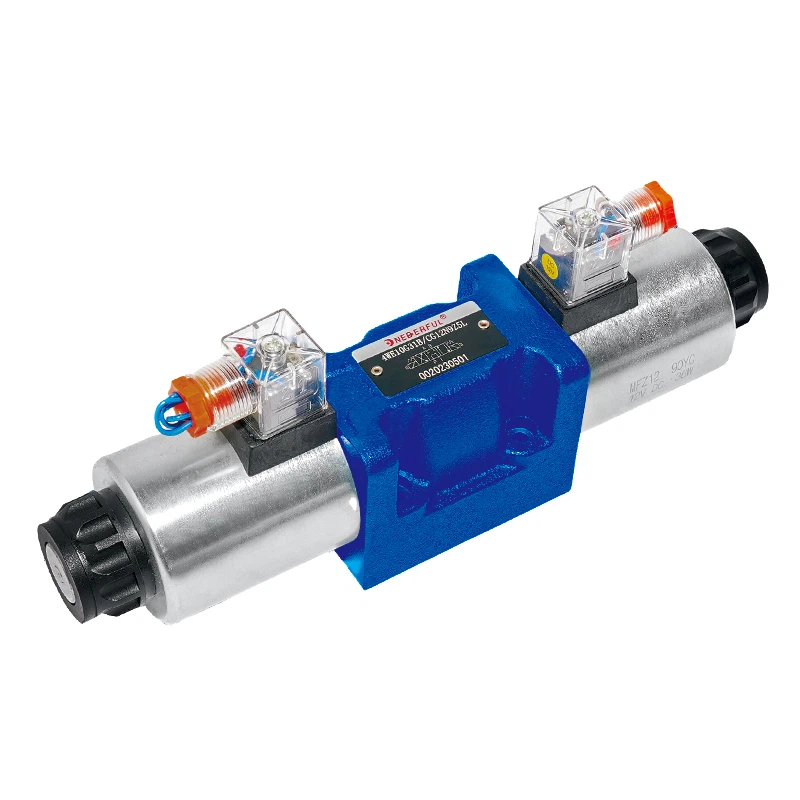
Shijiazhuang Laiye Import& Export Trading Co., Ltd. is one of the leading manufacturers and suppliers of 4we10 series high-performance solenoid operated directional valve in China, also supports customized service. If you're going to wholesale high quality 4we10 series high-performance solenoid operated directional valve made in China, welcome to get pricelist from our factory.
Products Description

The 4WE10 series high-performance solenoid operated directional valve is a direct-operated solenoid directional control valve with an NG10 interface, featuring a mounting pattern compliant with the ISO 4401 standard. It supports a maximum operating pressure of 350 bar and a rated flow of 120 L/min, making it suitable for medium-flow hydraulic systems. Spool configurations include 4/3-way and 4/2-way options. The valve utilizes a wet-pin solenoid design with coils rotatable by 90°; voltage options include DC 12V/24V or AC 110V/220V. It features an IP65 protection rating and an operating temperature range of -30°C to 80°C.
Direct solenoid actuation ensures rapid response, eliminates pilot delay, and results in short switching times. The NG10 size balances high flow capacity with compact installation dimensions, making it ideal for integration into medium-sized hydraulic systems. Coils are individually replaceable, manual override is standard, and various center-position spool configurations are available. It is widely used in industrial machinery, construction equipment, and automated production lines requiring medium flow rates, high-frequency switching, and precise directional control.
1. Valve Body Casting
The valve body is made of high-strength cast iron and formed in a single step using a precision casting process. Key controls during casting-such as molten alloy temperature, pouring speed, and solidification pressure-ensure a uniform, dense internal microstructure free from defects like gas porosity or shrinkage cavities. The casting requires the formation of multiple valve bores and flow channels, placing high demands on casting quality.
2. Casting Cleaning
The raw castings undergo processes such as shot blasting (to remove sand) and the cutting off of gates and risers to eliminate surface sand and flash. Specialized cleaning is required for internal oil passages to remove residual sand that could impair subsequent operation.
3. Precision Machining
The cleaned castings undergo multiple machining stages on high-precision machining centers: milling mounting surfaces; drilling oil ports and threaded holes; precision machining valve bores and internal flow channels; and machining seal grooves. Machining precision for valve bores and spools is stringent, typically requiring tolerances within 0.001 mm. Burrs generated during machining are promptly removed to ensure smooth spool movement.
4. Spool Machining and Heat Treatment
Spools are manufactured from high-quality alloy steel and precision-ground to ensure the correct fit clearance with the valve bore. Critical components undergo heat treatment according to design specifications to enhance surface hardness and wear resistance, thereby extending service life.
5. Assembly
Assembly takes place in a clean environment. Spools and valve bodies are matched based on actual machined dimensions to achieve optimal clearance, ensuring smooth sliding performance and effective sealing.
6. Final Inspection
Before leaving the factory, every valve undergoes pressure testing, internal leakage checks, directional response testing, and flow performance verification to ensure all product specifications meet design requirements.

| Technical Data | |
| Items | 4WE10 |
| Max pressure | 315 bar |
| Max flow | 120L/min |
| Working voltage range | ±10% |
We are a professional manufacturer of hydraulic valves integrating R&D, production, and sales. Leveraging the proprietary facilities of our parent company, Hebei Wendefu Hydraulic Technology Co., Ltd., we possess comprehensive in-house manufacturing capabilities spanning the entire value chain-from casting and precision machining to assembly and testing. Our factory is equipped with high-precision machining centers and CNC equipment, ensuring computerized control over critical processes. Valve bodies are precision-cast from high-strength ductile iron, while valve spools undergo carburizing, quenching, and hard chrome plating to ensure superior wear resistance and durability. Every product undergoes rigorous testing-including pressure resistance, internal leakage checks, and flow performance trials-prior to shipment. We hold ISO9002 quality management system certification and maintain full traceability throughout the production process. Our products are exported to over twenty countries and regions, including Russia, Europe, the Middle East, South America, and Southeast Asia.

Product quality inspection
1. Pressure Resistance Test
The valve body undergoes a pressure resistance test at maximum operating pressure to verify its structural strength and sealing performance, ensuring there is no leakage or deformation.
2. Internal Leakage Test
Internal leakage at each port is measured to ensure it falls within permissible limits. For pressure-holding components such as pilot-operated check valves, the internal leakage rate is a key indicator of sealing performance.
3. Switching Response Test
The response time of the spool is tested upon energization of the solenoid to ensure rapid and reliable switching action.
4. Flow Performance Test
Flow capacity and pressure drop are verified at the rated flow rate to ensure the product operates correctly within the system's flow range and that the pressure drop remains within acceptable limits.
5. Opening Pressure Test
The opening pressure of the check valve is verified against the set value to ensure sensitive opening and reliable closing.
6. Pilot Function Test
Reliability of reverse opening and response time under pilot control pressure are verified to ensure proper pilot function.
7. Appearance and Cleanliness Inspection
The quality of the valve body's surface finish, the integrity of markings, and the cleanliness of internal oil passages are inspected to prevent contaminants from entering the system.

FAQ
Q: Are the maintenance costs for the 4WE10 high?
A: No, they are not. Its direct-acting design is simple, with few potential points of failure. The coil can be replaced individually, and the seals are standard parts that are easy to replace. Overall maintenance costs are low.
Q: What is the problem if the valve does not actuate when the solenoid is energized, yet operates via the manual override?
A: If the solenoid shows no response when energized but the valve operates via the manual override, it indicates that the valve spool is not jammed; the issue lies with the solenoid or the electrical components.
Q: What causes the 4WE10 series high-performance solenoid operated directional valve to fail to maintain pressure in the neutral position?
A: First, verify the neutral position function. Theoretically, an O-type neutral configuration blocks all ports; however, pressure loss can occur if excessive internal leakage arises from spool or sleeve wear, if seals are damaged, or if contaminants prevent the valve from closing tightly. Minor wear can be remedied by polishing, but severe wear requires replacing the spool assembly.
Q: Why is the manual emergency override on the 4WE10 stuck or immovable?
A: The issue could be caused by debris entering the emergency mechanism or internal parts rusting. First, try cleaning the mechanism with a cleaning agent; if it remains stuck, disassembly and repair will be necessary. It is recommended to operate the emergency button periodically to prevent it from seizing up.
Q: What causes the actuator to move slowly after the 4WE10 valve shifts?
A: Slow actuator movement may be caused by insufficient system flow, flow restriction in the piping, or the valve spool failing to shift fully. First, check the system flow and piping, then verify whether the spool has fully reached its intended position.
Hot Tags: 4we10 series high-performance solenoid operated directional valve, China 4we10 series high-performance solenoid operated directional valve, manufacturers, suppliers, factory, direction flow control valve, directional control valve spool, hydraulic directional, hydraulic monoblock solenoid directional control valve, pilot operated directional control valve, solenoid controlled hydraulic valves